
Personalised Hair Restoration Planning • Sapphire FUE Recipient Channeling • Doctor-Led Scalp Care in Ashok Nagar
Hair loss and a receding hairline can affect confidence and appearance. Modern hair restoration techniques offer options for people experiencing pattern baldness, thinning hair and hairline recession. At Beautious Aesthetics Hair & Skin Clinic, Chennai, we focus on personalised hair restoration planning and doctor-led treatment.
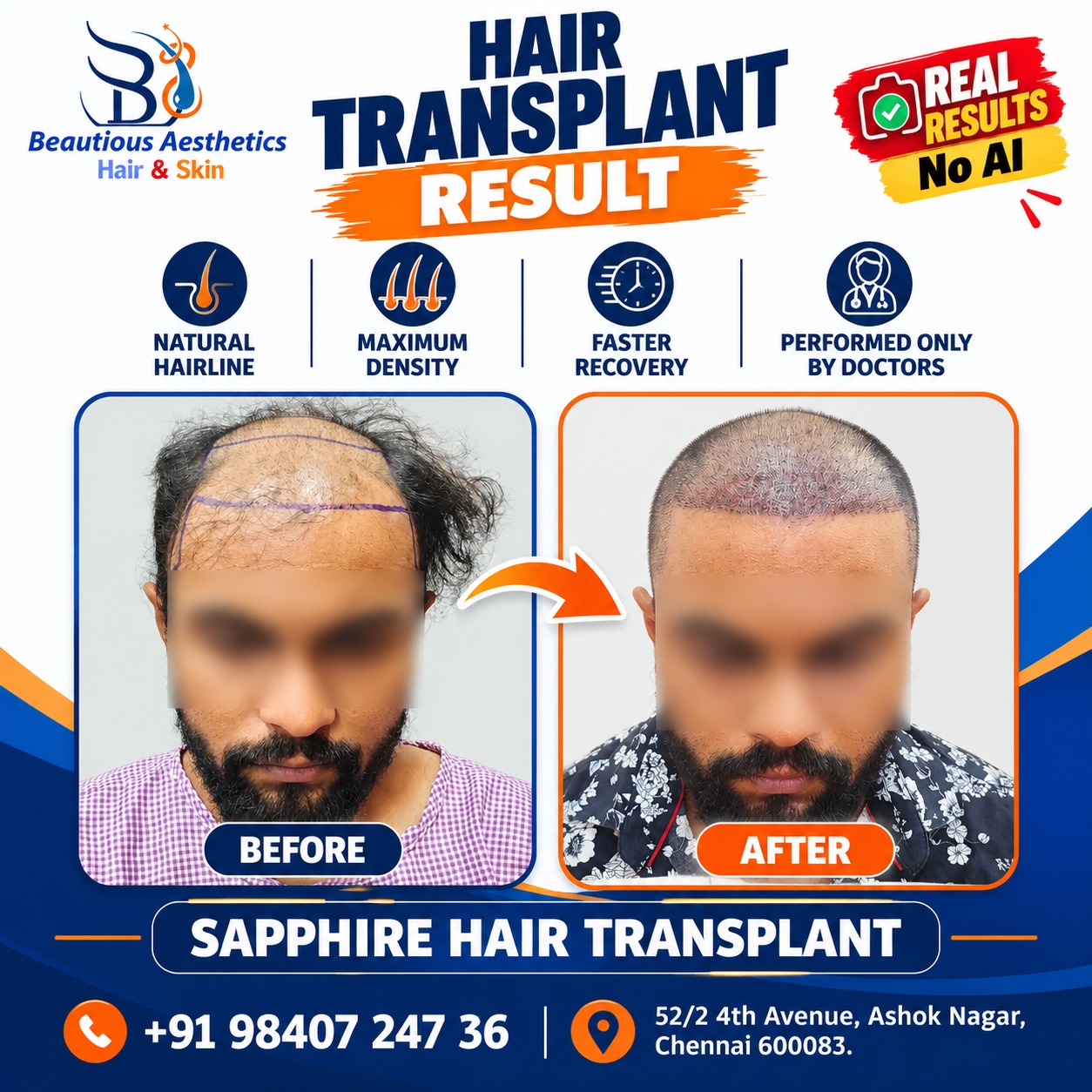
Our featured Sapphire Hair Transplant case showcases a reported total of 4,623 follicles, highlighting the patient’s hairline design and immediate post-procedure appearance. Every hair transplant journey is individual, and the final outcome develops gradually over the following months.
Sapphire FUE (Follicular Unit Extraction) is a hair transplantation technique in which individual follicular units are extracted from the donor area, usually the back or sides of the scalp. Sapphire-tipped blades are used to create recipient sites for placing the harvested grafts.
The surgeon plans the hairline, direction, angle and distribution of the grafts according to the patient’s facial proportions, donor hair availability and pattern of hair loss. The goal is to achieve a natural-looking hairline and appropriate coverage while protecting the available donor hair.
V-shaped sapphire blades create smooth, micro-incisions that allow precise recipient channel opening with minimal tissue disruption.
Graft direction, exit angle and distribution are customized to match the patient's individual facial contours and age profile.
Individual follicular units are harvested evenly from the donor zones to safeguard donor density for the present and future.
The featured case highlights a reported total of 4,623 follicles in the treatment plan. This number should be interpreted according to the clinic’s documented counting method, as follicles, individual hairs and follicular grafts are not the same measurement.
The before-and-after photographs show the patient’s scalp before treatment and the immediate post-procedure appearance. The second photograph illustrates the newly implanted area; it should not be interpreted as the final hair-growth result.
A hair transplant requires time for healing and new growth. The final density and appearance depend on graft survival, donor hair characteristics, the extent of hair loss and individual healing.
Naturally occurring groupings of hairs found on the scalp. A single harvested graft typically contains between 1 to 4 individual hairs.
The biological root structures residing beneath the scalp from which individual hair shafts grow. In this case, 4,623 follicles were planned.
The visible hair strands emerging from the skin surface. One patient's graft count and follicle count may differ based on counting protocol.
Medical Clarification: Always discuss counting conventions during your pre-procedure consultation so you understand whether figures represent grafts, follicles or individual hairs.
Potential benefits of a carefully planned hair transplant include:
Hairline placement and graft direction are planned to suit the individual, respecting natural irregular transitional zones in the frontal margin.
Transplanted follicles can help cover selected areas affected by pattern baldness, establishing a fuller appearance across targeted zones.
The number and distribution of grafts are tailored to the patient’s needs and donor capacity, avoiding over-harvesting.
Transplanted follicles can provide lasting growth, although surrounding native hair may continue to thin, requiring ongoing medical management.
A medical assessment helps determine whether transplantation is suitable and what results are realistic, balancing long-term hair genetics with current restoration goals.
Important Scientific Note: Sapphire blades do not guarantee superior density, faster recovery or better graft survival. Outcomes depend on surgical planning, the experience of the treating team, graft handling and aftercare.
Hair restoration is an evolutionary biological journey rather than an overnight transition. Below is the typical milestone timeline following procedure day:
The scalp may develop redness, swelling, crusting or tenderness. Follow the clinic’s washing and aftercare instructions carefully.
Transplanted hair shafts commonly shed temporarily. This is a normal part of the hair-growth cycle and does not necessarily mean the follicles have been lost.
Early new growth may begin to appear, although coverage can remain limited as fine hairs first start sprouting through the scalp.
Hair growth and visible coverage often become more noticeable, with thickening hair shafts and improved cosmetic density.
Many patients can assess a substantial portion of their result, although some continue to improve beyond this point with further maturation.
The timeline varies between individuals. Regular follow-up with the treating doctor helps assess healing and progress.
Hair transplantation may be considered for adults with pattern hair loss who have an adequate supply of healthy donor hair and a suitable recipient area. A consultation should assess:
Medical Reality: Not everyone with hair loss is an ideal candidate. Medical treatment may be more appropriate in some cases, and a doctor may recommend stabilising ongoing hair loss before considering surgery.
At Beautious Aesthetics Hair & Skin Clinic, we aim to provide personalised guidance throughout the hair restoration journey. Our approach includes consultation, assessment of hair loss, treatment planning and post-procedure care.
We encourage every patient to understand the proposed technique, expected recovery, potential risks and realistic outcomes before making a decision. If you are researching a hair transplant in Chennai, a consultation can help you understand which treatment options may be appropriate for your hair loss pattern.
Thinking about restoring your hairline? Contact Beautious Aesthetics to discuss your concerns and arrange a consultation with the clinic. Take the first step towards understanding your hair restoration options with a personalised medical assessment.
52/2, 4th Avenue, Ashok Nagar, Chennai – 600083
This article is for general educational purposes and does not replace a medical consultation. Results vary by patient. The featured photographs represent the stages shown and should not be taken as a guarantee of final results.
Sapphire FUE is a hair transplantation technique where individual follicular units are extracted from the donor zone, and recipient channels are created using specially crafted sapphire-tipped blades. The surgeon plans graft direction, angle, and density based on the patient's individual facial proportions and donor availability.
The featured case highlights a reported total of 4,623 follicles in the treatment plan. This number is interpreted according to documented counting methods. It should be noted that follicles, individual hairs, and follicular grafts (which often contain 1 to 4 hairs each) represent distinct clinical measurements.
No. The second photograph illustrates the newly implanted recipient area immediately post-procedure. A hair transplant requires time for healing, temporary shedding of the hair shafts, and gradual new growth over 6 to 12 months.
Sapphire blades do not guarantee superior density, faster recovery, or better graft survival on their own. Outcomes depend primarily on comprehensive surgical planning, graft handling, surgeon skill, and diligent post-operative aftercare.
Temporary shedding (often called shock shedding) is a completely normal physiological reaction in the hair growth cycle. The transplanted hair shafts fall out while the implanted roots/follicles remain firmly in place beneath the scalp, preparing to produce new, permanent hair shafts from month 3 onwards.
Beautious Aesthetics Hair & Skin Clinic is located at 52/2, 4th Avenue, Ashok Nagar, Chennai – 600083. You can reach our team via phone at +91 98407 247 36 or explore our treatments online at https://beautiousclinic.com/.
Take the first step towards understanding your hair restoration options with a personalised medical assessment at Beautious Aesthetics, Chennai. Discuss your hair loss pattern, donor availability, and achievable outcomes with our doctor-led team.